BTWC

Tuesday, 23 November 2010

John Dillinger is a Hero of Whittling


Dillinger, right.

John Dillinger, bank robber, is a hero of whittling. Having previously busted out of jail with smuggled rifles and the accomplices who would eventually form his first high profile bank robbing gang, JD -- finding himself incarcerated once again -- whittled a gun from a wooden washboard, coloured it black with shoe polish, and escaped once more using the facsimile firearm.

Here the story is somewhat obscured by myth, contradiction, and Wiki-facts. It is speculated that the gun was in fact fabricated by police to cover up the embarrassing fact that Dillinger had successfully received smuggled firearms in prison, again, or to distract from a different truth, that he simply bribed his way out.

But the whittled gun story holds water. In a post-breakout photograph, Dillinger is pictured holding a Tommy gun and a small rudimentary looking gun, which could well be wooden. The John Dillinger Museum of Hammond, IN, has shown a gun claiming to be the one in the picture; it has a rounded barrel and, for want of enough wood, only a partial handle. In use, the missing handle area would be covered by the hand, rendering it convincing. Ineffectually gouged into the side is the legend “COLT 38”, an example of JD’s sarcastic sense of humour, maybe. This gun, however, is manifestly not the item sold on historical auction site Heritage Auction Galleries for $19,120 in December 2009. That gun has a rather square barrel, and several other differing features. According to that website, there are three guns with credible claims to being the one used by JD. This one came down through the Dillinger family; think of that what you will.

John Dillinger display at BTWC show with a copy of the copy of a Colt 38

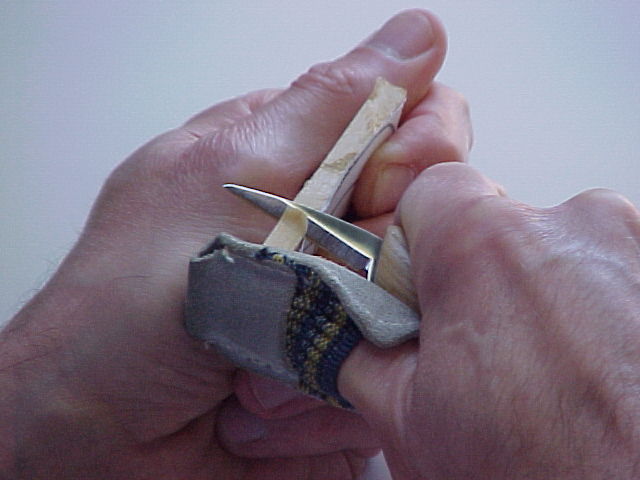
There are several notable points of craft on the gun. The replica of the facsimile which was produced by Bleeding Thumb member Jana is fairly uncomfortable to hold. In the photo with JD, the same awkward grip that I was forced to use can also be seen. Several intriguing details are listed on the Heritage Auctions description: that the barrel was lined with a little copper pipe – to reflect light with the characteristic metallic glint that anyone familiar with guns would expect and recognise? That small nails were used to create the illusion of sights on the weapon – the tiny details of silhouette that an artist or expert knows will complete an illusion. On creation, the black shoe polish coating the gun would have had the deep gleam of burnished steel. Seeing it wielded with confidence by the swaggering Dillinger, it is easy to imagine being convinced. Internet forums debate how JD could have gotten the knife to whittle the board, but the construction could certainly have been carried out with an old style flat razor-blade.

Dillinger is sometimes looked upon as a Depression-era Robin Hood figure, but from my readings, his redistribution of wealth was not significant. More endearing is the sense of audacity he embodies, like Bonnie and Clyde, in moving in an arena of bluster and romanticised anti-morality which cannot be explored today. Robbing banks with a big mouth and sticking it to J Edgar Hoover personally, and good for him too! John Dillinger was eventually killed by the feds in an ambush outside a movie theatre. The fatal wound entered the back of his neck. He was running towards an alleyway and had not yet drawn a gun.

The cinema in Chicago where Dillinger died

Sunday, 14 November 2010

Ply-pattern


Monday, 8 November 2010

Blades on my mind


First using, and then collecting knives, you eventually end up wanting to make one yourself. So I made a knife some time ago & decided recently to try to do it more regularly. I´m not in the position to make my own blades quite yet so I stick with my pre-made favorite; the 'Erik Frost 120', and concentrate on the handle design for now. The first few knives have been very simple and traditionally Scandinavian, but since Jack started to leave Japanese tools around the wood-workshop I kind of got the desire to make a knife inspired by the Japanese Kiridashi knives.

The Kiridashi is a general utility knife used for cutting, marking or carving. They have a simple chisel ground edge and look a bit like a scalpel since they don´t normally have a handle. What interested me in these blades is the way that they are sometimes inset in a block of wood where one continuous bit is used as both handle and sheath. I tried to use this technique but with a long Mora blade. Im not sure of the technical success of this combination, but the looks are sort of in the right spirit. This knife wont be any good for chopping so I´ll give it to my mom with the hope that she will use it to cut her Polish sausage using the paring/pull cut.


Walnut wood and aluminium inlays

Wednesday, 3 November 2010

Rock, Paper, Scissors; Steel versus Stone


Steel beats wood, stone beats steel...


In the course of whittling wood, especially harder woods like pear, box, and lignum vitae, it is not unusual for the edge of one's blade to become round, rubbish, and worthless. Don't throw it away! You must sharpen it! But how? With all that time taken to carefully select your perfect knife, equally you must find your ideal method of sharpening.

What is a sharp edge?

A nice maxim regarding edges: "A sharp edge is the intersection of two mirror polished surfaces".

We can think about this on a microscopic scale. When a blade is blunt, it is rounded over. When ground, it gets a sharp cross-section, but it has microscopically tiny jagged teeth along the edge. When used, these will bend over and stop the blade working well. The aim of using finer and finer sharpening stones is to make these teeth small, smaller, vanishing, then you have a nice glass-like edge. Ow. The angle of the edge determines how tough it will be, and only the very last part of the edge needs to be highly polished...

Sharpening Stones

The usual way of sharpening is on a set of sharpening stones. If your blade is badly chipped (chips 1mm or bigger) or the sides of the bevel rusted, you may need to use a coarse stone (coarse=grinding), something like a few hundred grit. If you can't be bothered to buy this stone, you can clip some wet-and-dry paper of a similar grit to a perfectly flat surface - I use a granite pastry block from Sainsbury's.

After you've got the chips out and the sides are clean, you can move on to the medium stone (800-1200 grit, medium=sharpening), then the fine (3000+, fine=honing). I use a Japanese combination water-stone which is 1000 on one side and 6000 on the other. The last stage in sharpening a knife is to use a leather strop to buff it. This is simply a piece of leather nailed to a block of wood which polishes the cutting edge, and can be used at the end of each whittling session to prolong the life of the edge. It only takes on the order of a few minutes on each stone to get the blade sharp.

Once the edge of the blade is honed, it is usually sufficient to use just the fine stone and strop to maintain the edge, unless heavy work dings it out of shape.

Information abounds on the net regarding how to sharpen knives, much of it contradictory of course. These gents talk primarily from the point of view of kitchen knives but I find their explanations on the motion involved in sharpening to be helpful:

Expert Village
Murray Carter

Some more technical info can be found here:

Fine Tools 1
Fine Tools 2

This is in contrast to one web-page that I came across that would have you believe sharpening a chisel takes 12 hours -- when would you get to use the thing? There are many techniques, and the only way to understand them is to try them out; ultimately, you will know that you are sharpening well because your blade will get sharp. Do not get discouraged! It takes a little trial and error.

There exist both oil-stones and Japanese water-stones. oil-stones last pretty much forever while water-stones eventually wear out. In my experience, water-stones are quicker and easier to use. Because of their fast action, I would especially recommend them if your knife is of very hard stainless steel, but then I would recommend them anyway. I use a 1000 and a 6000 grit water-stone and finish with a strop. The blade achieved is sharp enough to shave with (if you are a sailor and can take a rather tough shave). However, I also have oil-stones, including a very fine and old one purchased from Deptford market. For some reason, I like to sharpen certain tools on the water-stones, and certain on the oil-stones -- I've no idea why.

BTWC offers knife-sharpening services and instruction, in fact we always have.

Japanese Tools 1 -- Nokogiri (Saws)


"Form follows function" is a truism, so where do we find it lacking explanatory power? Several familiar tools take interesting twists in design in Japan. For instance, while Western saws cut on the push stroke, Japanese cut on the pull, placing the blade under tension and keeping it straight.

Let me relate the story of this impressive saw. Before the advent of mechanised milling, these Maebiki-Nokogiri were used in Japan to mill raw lumber down to flat boards. The huge flat body is to guide the blade straight along the entire length of the tree. Note also the teeth -- smaller near the handle for initiating the cut then more coarse further along, a standard feature of Japanese saws. It was said that the sawyer who used the one in the picture was over six feet tall and ate two litres of rice at each meal. Said also that he, a master of his trade, would serve tea to his apprentice. How cool.

Thursday, 21 October 2010

Whittling at the Woodmill


Our 9th meeting took place at the Woodmill studios in connection with the Heat Haze outdoor sound seminars. We had the pleasure to whittle while listening to Mark Pilkington's talk on 'Western occult tradition, told through British popular music' & the evening ended with a screening of William Eggelston´s film ´Stranded in Canton´.


Note plaster


Little horse on pillow by Ksenia


Multi-tailed cat by Jana


soft object by some visitors


A young boy called Liam dropped by the Woodmill and did some whittling while on his way home. Staying out way longer than he really should, he figured he could appease his mothers rage by whittling her this heart.

Cat by Little Jack

Jack´s finished spoon.

Sunday, 17 October 2010

Paper Birch


There is a street in north London lined with Paper birch trees. The thin bark is peeling of the trunks in crisp layers and if you get hold of a piece you can pull it right of in the size of a page. The bark can be separated into extremely thin, but still durable and flexible sheets, a quality that explains why it was frequently used as an early writing material. There has been hundreds of old Birch bark letters uncovered around the Novgorod area in Russia. Some of them date back as early as the 11th century. The famous mathematical Bakhshali manuscript was also written on birch bark and is believed to be from somewhere between 200 BC - 300 AD. It might be one of the earliest documents to use the concept of zero (0).

Monday, 4 October 2010

Soviet knives


These knives were made by my grandfather a long time ago in Ukraine during the scarce days of the USSR. It was very hard to get hold of a lot of things so my granddad made these in the factory where he worked from some scrap. Pretty nice job with proper rivets and so on.

Monday, 30 August 2010

Trent Park


A couple of us decided to take a trip out to a forest to try some green wood whittling. During the seasoning (drying) process (which may take some years for large logs), wood loses around 40% of its mass as water leaves the fibres, leaving the wood stable and unlikely to crack or warp too much when it is finally used. Before this has occurred, the wood is called green. Green wood is usually much softer and is frequently used for carving smaller or disposable objects where stability over time is not important.

We settled on Trent Park in North London and as we arrived and started to make our way through the oak-woods we decided to penetrate the forest beyond the designated paths. Our explorative spirit brought us to crawling through dense vegetation of fern and nettles for ten minutes before we gave up and made our way back to the trails.


Most of the fallen wood in the forest was in a semi-disintegrated state and so totally unsuitable for whittling but were on the other hand a perfect growing ground for mushrooms. We were instantly mesmerized by the fungi life-form and abandoned our search for wood in favor of the bizarre and diverse species of mushrooms.

We came across a great many different types. Slimy, dry, miniature and some that looked like an exploded alien. The most useful mushroom for a whittler is probably the birch bracket (also known as razor strop fungus) which - sliced and dried - can be used to get a really fine edge when honing of a knife.

Characteristic spongy cap of the bolete family of mushrooms


As we strolled out of the woodlands and onto the open fields, we came across a dislocated limb from an oak-tree that Jack cut up with the foldable saw. The wood was very damp and quite hard, but we still managed to carve some odd spoons.

On the way home, we drove past the 1930s Piccadilly Line extension's beautiful stations at Southgate, Oakwood, etc., built in a kind of English garden city-Bauhaus-Stijl, geometric fundaments and elegant window frames.


Wood frame


My sisters wooden frame glasses. Think they are made by some Japanese designer.