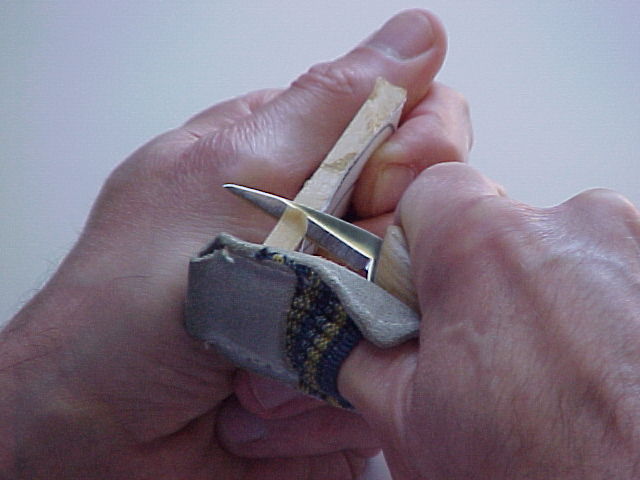
First using, and then collecting knives, you eventually end up wanting to make one yourself. So I made a knife some time ago & decided recently to try to do it more regularly. I´m not in the position to make my own blades quite yet so I stick with my pre-made favorite; the 'Erik Frost 120', and concentrate on the handle design for now. The first few knives have been very simple and traditionally Scandinavian, but since Jack started to leave Japanese tools around the wood-workshop I kind of got the desire to make a knife inspired by the Japanese Kiridashi knives.
The Kiridashi is a general utility knife used for cutting, marking or carving. They have a simple chisel ground edge and look a bit like a scalpel since they don´t normally have a handle. What interested me in these blades is the way that they are sometimes inset in a block of wood where one continuous bit is used as both handle and sheath. I tried to use this technique but with a long Mora blade. Im not sure of the technical success of this combination, but the looks are sort of in the right spirit. This knife wont be any good for chopping so I´ll give it to my mom with the hope that she will use it to cut her Polish sausage using the paring/pull cut.


Walnut wood and aluminium inlays




 Posts
Posts